
Most flooring failures don’t show up on install day — they show up six months to a year later, after the crew is long gone. Here are the seven warning signs our installers look for when we’re called in to fix someone else’s job, what causes each one, and what a correct install looks like instead.
1. A floating floor that was nailed or glued down
Floating floors — most luxury vinyl plank (LVP) and many laminate products — are engineered to lock together and move as one connected sheet, expanding and contracting with the seasons without ever touching the subfloor beneath. When an installer nails or glues that floor down “to keep the plank from shifting,” they’ve defeated the entire design. The floor can no longer move the way it’s built to, so instead of a small, even seasonal shift, you get concentrated stress at the fastened points — planks that pop up, buckle, or separate at the seams within a year. If your floating floor has visible nail heads, adhesive squeeze-out along the edges, or was described to you as “held down for stability,” that’s not a normal part of an LVP or laminate install — it’s a shortcut.
2. No expansion gap at the walls
Every hardwood, laminate, and floating vinyl floor needs a small gap — typically 1/4″ to 1/2″ — between the flooring’s edge and the wall, hidden later by baseboard or shoe molding. Wood-based and wood-look materials absorb and release moisture with Middle Tennessee’s humidity swings, expanding in summer and contracting in winter. Without that gap, the floor has nowhere to expand into: it pushes against the walls and buckles upward, or it cups at the seams. If your floor is tight wall-to-wall with no reveal under the baseboard, or you’re seeing ridges form along the perimeter of a room after a humid summer, a missing expansion gap is the likely cause.
3. New flooring laid directly over old, failing flooring
Installing over an existing floor is sometimes fine — but only when that floor is flat, stable, and structurally sound. Laying new planks over an old floor that’s already delaminating, curling, or popping up just transfers the same instability to the new material, and hides a subfloor problem instead of solving it. It also means any moisture or leveling issue underneath goes uninspected. If your old flooring was buckling or falling apart before the new floor went down, it should have been torn out — not built over. We cover this in more depth in our guide on when it’s safe to install over old flooring and when it isn’t.
4. Hollow-sounding spots underfoot
Walk a properly installed floor and it should sound and feel consistent everywhere. A hollow “thonk” in specific spots usually means the subfloor wasn’t leveled or fastened correctly before the new flooring went down — a low spot, an uncorrected dip, or a section of subfloor that isn’t fully secured. Over time, hollow spots tend to get worse, not better, as foot traffic works the gap. This is exactly why proper subfloor prep matters more than the flooring material itself; we go into what that prep actually involves on our subfloor prep and moisture remediation page.
5. Visible gaps or lippage between boards
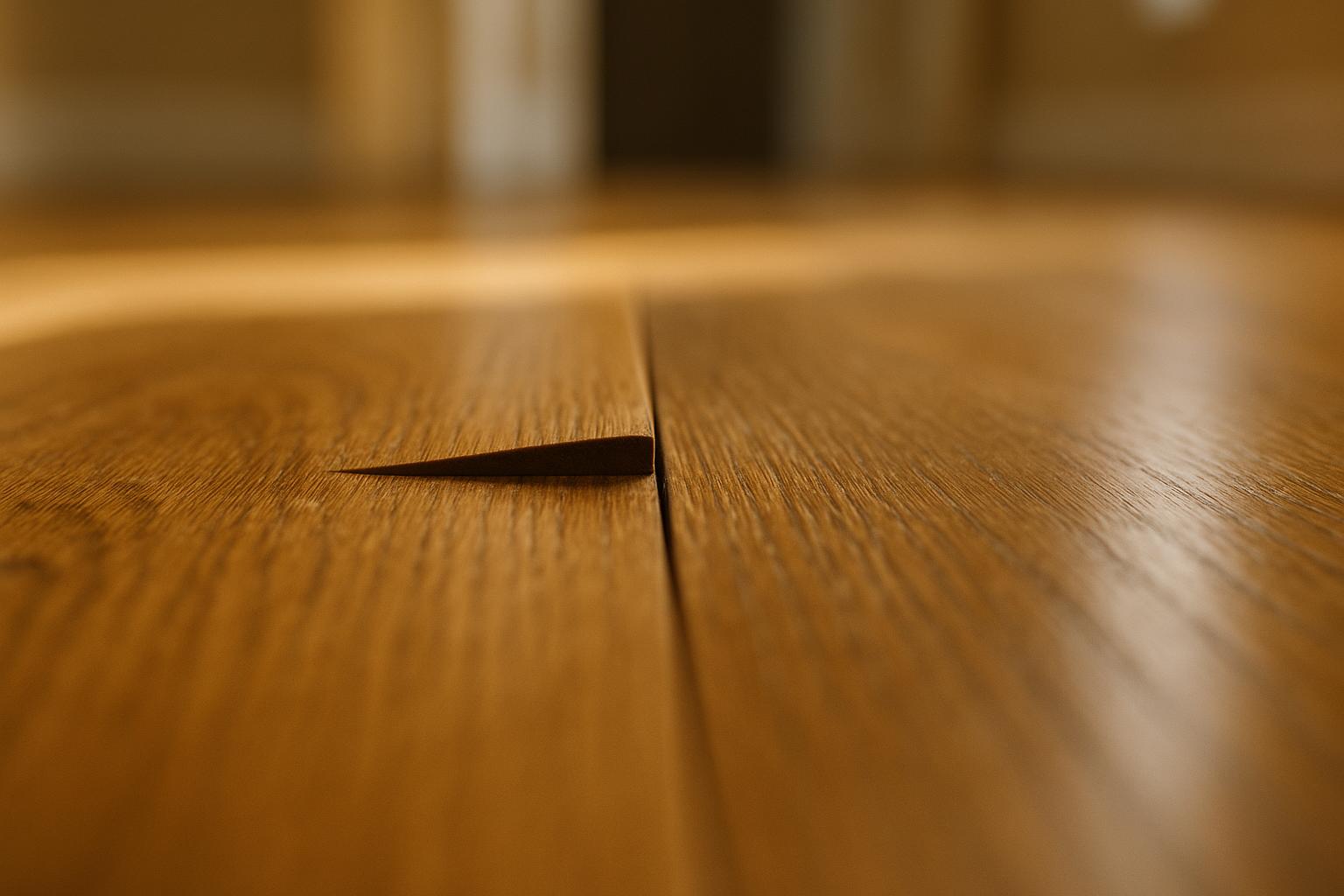
Lippage is when one plank or board sits noticeably higher than the one next to it — you can feel the edge with your foot, or see a shadow line where they meet. Gapping is when boards visibly separate, leaving a sliver of open space at the seam. Both point to the same root causes: an uneven subfloor, boards that weren’t acclimated to the room’s humidity before installation, or a rushed installation where planks weren’t properly seated and locked. A small amount of seasonal gap movement is normal in solid hardwood; persistent lippage or gaps right after installation are not.
6. New squeaking that wasn’t there before
Squeaks happen when flooring rubs against a fastener, subfloor, or adjacent board that isn’t fully secured. A squeak that develops in the weeks after a new installation — especially in a spot that never squeaked before — usually means a fastening or subfloor issue introduced during that install, not normal aging. It’s worth flagging early, since squeaks caused by movement can point to a larger stability problem underneath.
7. Cupping or crowning in hardwood boards
Cupping is when the edges of a hardwood board rise higher than its center, giving the board a shallow U-shape you can feel underfoot. Crowning is the opposite — the center rises above the edges. Both are almost always moisture-related: the wood wasn’t acclimated to the home’s humidity for long enough before installation, or moisture is entering from below through a subfloor that was never tested. Solid hardwood needs time in the actual room it’s being installed in — often several days — to reach equilibrium with the home’s temperature and humidity before a single board goes down. Skip that step, and cupping or crowning can show up within months.
What a correct install actually looks like
None of these seven problems are complicated to prevent — they just take time that a rushed job doesn’t spend. On every installation, our crews test subfloor moisture before laying a single plank, level and secure the subfloor itself, acclimate wood and wood-look materials to the room, leave the correct expansion gap at every wall, and choose the right installation method (floating, glue-down, or nail-down) for the actual product — not whatever’s fastest. That’s the difference between a floor that looks good at handoff and one that still looks good in ten years. It’s also why we’ve been doing this for over 20 years: done right the first time costs less than doing it twice.
Frequently asked questions
I’m seeing one or two of these signs — is my floor actually failing, or is this normal wear?
A little seasonal gap movement in solid hardwood, or a very faint sound in one board, can be normal. But lippage, hollow spots, cupping, or a floating floor that was fastened down are not normal wear — they’re installation issues that tend to get worse over time, not better. If you’re not sure which category you’re in, a free in-person look from an experienced installer is the fastest way to find out before it becomes a bigger repair.
Can any of these problems be fixed without replacing the whole floor?
Often, yes. Isolated lippage, a few squeaking boards, or hollow spots from a small subfloor void can frequently be corrected without a full tear-out. Widespread cupping, a floating floor that was glued or nailed across most of a room, or new flooring laid over failing old flooring usually does require pulling up the affected area and correcting the subfloor before relaying it. We can tell you which situation you’re in during a free quote visit. See our wood floor repair and flooring repair services for more on what we can typically save versus replace.
How long after a bad installation do these problems usually show up?
It varies by cause. A missing expansion gap or acclimation issue often shows up with the first full change of season — commonly within 6 to 12 months, as humidity swings through a summer or winter. A nailed-down floating floor or unlevel subfloor can show hollow spots or lifting much sooner, sometimes within weeks. The common thread is that these issues are progressive: they tend to get more visible and more expensive to fix the longer they’re left alone.
Will a new installer be able to tell if my current floor was installed wrong?
In most cases, yes. An experienced installer can usually identify a missing expansion gap, a fastened floating floor, poor subfloor prep, or an acclimation issue on sight or with a simple moisture check — without pulling up the whole floor. That’s exactly what we look for during a free quote, whether you’re calling us to fix an existing problem or just want a second opinion before it gets worse.
Not sure if your floor was installed right?
If you’re seeing any of these seven signs, don’t wait for it to get worse. Get a free, no-pressure second opinion from an installer with over 20 years of experience in Middle Tennessee homes. Prefer to talk now? Call (615) 551-7364.