
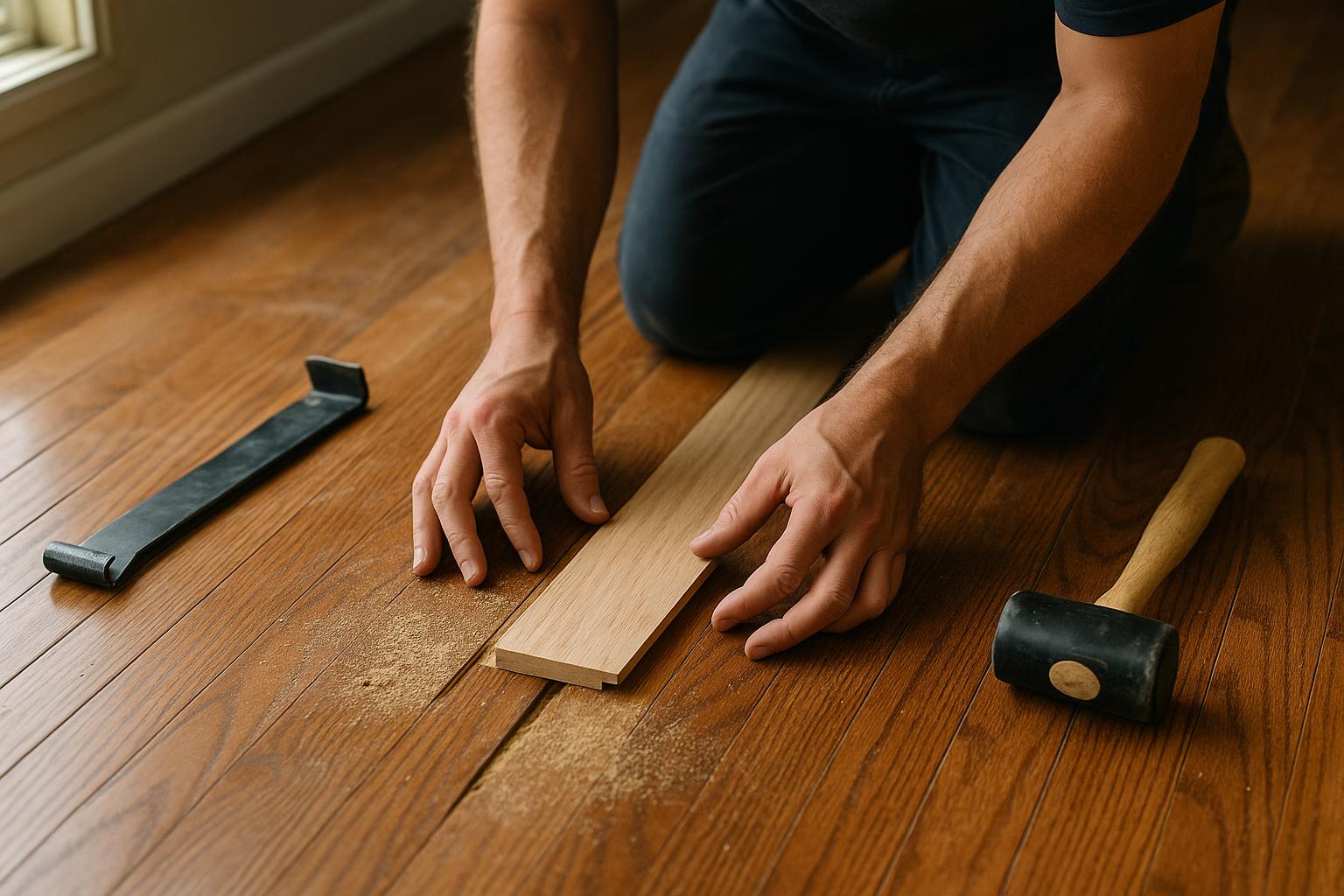
Hardwood is built to last decades, but it isn’t indestructible — boards get damaged, gaps open up, floors cup after a leak, and older installs start to squeak. Repairing hardwood well means matching the wood, understanding why it failed, and fixing the cause, not just the symptom — which is exactly what over 20 years of hardwood work in Murfreesboro and Middle Tennessee has taught our crew.
Common hardwood problems we repair
Most hardwood repair calls fall into a handful of recognizable categories:
- Damaged or broken boards — gouges, burns, deep scratches, or split planks that go past what refinishing can smooth out. Individual boards can often be cut out and replaced.
- Gaps between boards — some seasonal gapping is normal as wood expands and contracts, but large or permanent gaps can point to low indoor humidity, an install done without proper acclimation, or subfloor movement.
- Cupping and crowning — when boards curl at the edges (cupping) or dome in the middle (crowning), it’s almost always a moisture problem underneath, not a wood problem on top.
- Squeaks and movement — usually a fastening or subfloor issue, where boards rub against each other or against a subfloor that’s no longer held tight.
- Water and pet-stain damage — black stains, soft spots, or warping from a leak, an overflow, or long-term moisture that has gotten into the wood.
Repair, refinish, or replace — the honest call
Plenty of “damaged” hardwood floors only need surface work. If the problem is scratches, dullness, or light surface wear, wood floor refinishing handles it without replacing a single board. Repair comes in when the damage is structural — broken boards, water damage, cupping, or squeaks — and needs boards pulled, the cause addressed, and new wood woven in. Full replacement only makes sense when damage is widespread enough that piece-by-piece repair no longer adds up, and we’ll be straight with you about which category your floor falls into. For laminate, vinyl, and stone floors, repairs live on our flooring repairs page instead.
We fix the cause, not just the damage
Cupping, recurring gaps, and squeaks are usually symptoms of something underneath — a moisture problem, a subfloor that moves, an install done without proper acclimation or expansion gaps. Replace the boards without fixing what caused the failure and the same problem comes right back. That’s why we check what’s under the floor before we call a repair done.
How a hardwood repair works
-
Assessment
We look at the damage and, just as important, why it happened — moisture, movement, or wear — so the fix actually holds. You get a free quote and a callback within a day.
-
Board removal and matching
We cut out the damaged boards and match new wood to your floor’s species, size, and grain as closely as the existing product allows.
-
Repair and re-fasten
We address the underlying cause — moisture, a loose subfloor, missing expansion room — then weave in and secure the replacement boards.
-
Blend and finish
We sand and finish the repair to blend with the surrounding floor. Where a seamless match isn’t possible on an older floor, we tell you before we start.
Serving Murfreesboro and Middle Tennessee
We repair hardwood throughout our Middle Tennessee service area — Murfreesboro, Nashville, Smyrna, La Vergne, Brentwood, Mt. Juliet, Franklin, Spring Hill, and Shelbyville. Many older homes here have original hardwood well worth saving, and in a lot of cases a targeted repair plus a full refinishing brings a floor back better than a replacement would — at a fraction of the cost.
Frequently asked questions
Can you match new boards to my existing hardwood?
We’ll get as close as the existing product allows. An exact match depends on the species, the age of the floor, and whether that product is still made — older floors carry a patina that new wood doesn’t. In many cases refinishing the whole floor after the repair helps everything blend. We’ll tell you honestly what to expect before we start.
My hardwood floor is cupping — can it be fixed?
Cupping is a moisture signal, so the first step is finding and fixing the moisture source. Once the source is resolved and the wood dries out, mild cupping sometimes flattens back on its own. If it doesn’t, we replace the affected boards — but only after the moisture problem is corrected, so it doesn’t just happen again.
Why does my hardwood floor squeak?
Squeaks usually come from fastening or subfloor movement — boards rubbing together or against a subfloor that has worked loose. In most cases this is fixable without replacing boards, once we identify where the movement is coming from.
Do you repair water-damaged hardwood?
Yes, though how much can be saved depends on how deep the damage goes. Surface staining can sometimes sand out, but black stains, soft spots, or warping usually mean the affected boards need replacing — and the moisture source has to be addressed first. We’ll assess it and give you an honest read.
Get a free quote for your hardwood repair
Tell us what you’re seeing and we’ll call you back within a day with an honest read on repair vs. refinish vs. replace — no pressure.