
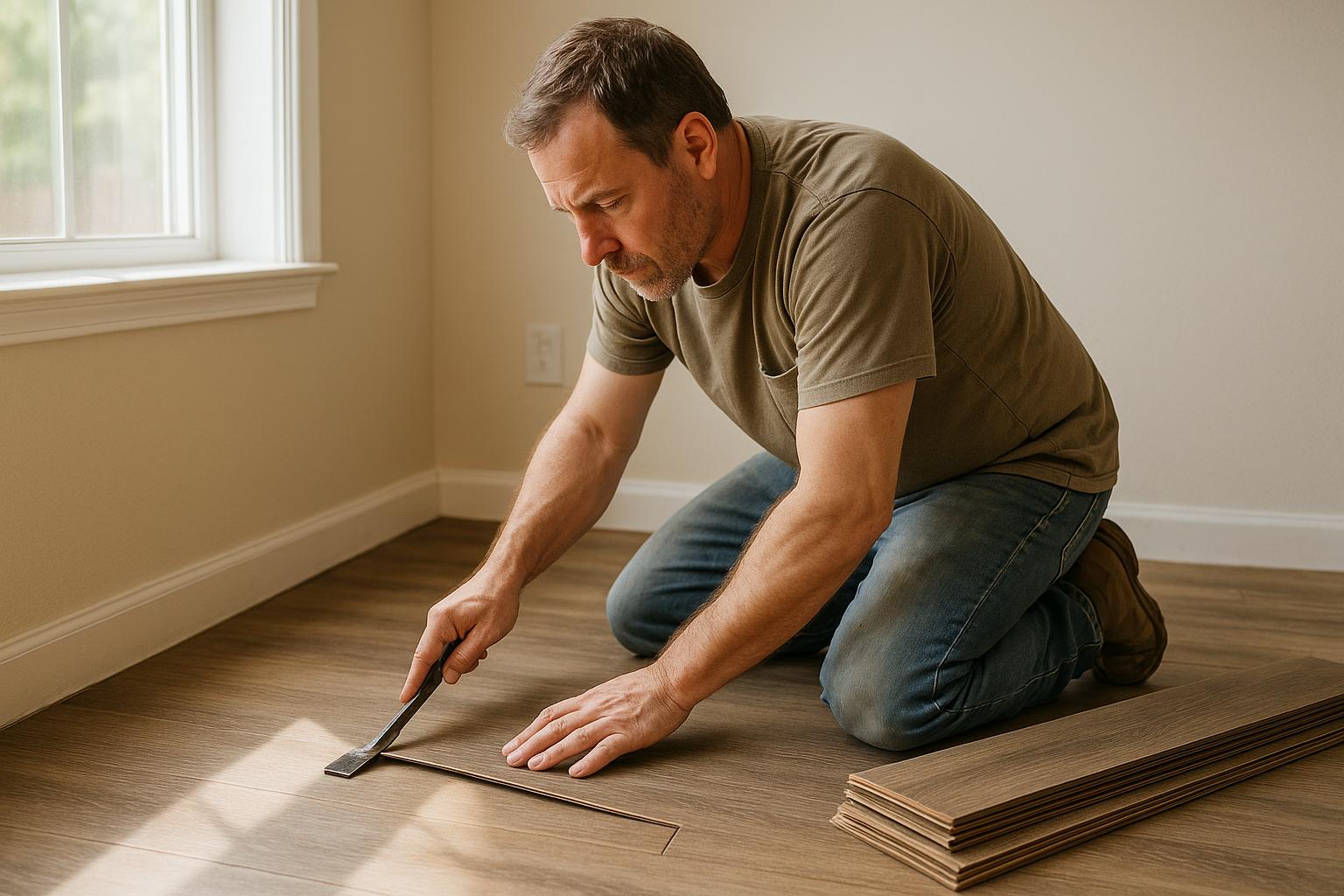
Laminate, vinyl, and marble floors fail differently than hardwood — and they get repaired differently too. If it’s a hardwood floor you’re looking at, our wood floor repair page covers that specifically. This page is about the other three: what typically goes wrong, and what an honest repair-or-replace call looks like.
Laminate: chips, water damage at the seams, peaking and buckling
Laminate takes damage in a few predictable ways. Chips and gouges happen at the wear layer — usually from a dropped object or a dragged appliance — and once the core is exposed, that spot is vulnerable to swelling if moisture gets in. Water damage almost always shows up at the seams first, since that’s where the locking joints sit and where the fiberboard core is most exposed; a swollen, dark, or crumbling seam is a sign water has already gotten into the core, not just the surface. Peaking and buckling — where boards push up and tent at a seam — is a different problem entirely: it means the floor was installed without enough expansion gap at the walls or transitions, so the floor had nowhere to go when it expanded and pushed itself up instead.
Repair or replace: A handful of chipped or gouged planks can be pulled and swapped, especially near a doorway or under furniture where a slightly different batch won’t stand out. Water-damaged seams are trickier — once the core has swollen, that plank isn’t coming back, but it’s often still a localized swap if it’s caught early. Peaking and buckling from a missing expansion gap usually means pulling boards back from at least one wall to cut proper clearance — patch the boards without fixing the gap, and the same ridge comes back the next humid season. If a room’s laminate has failed broadly enough that repair no longer makes sense, our laminate flooring installation covers a full replacement done with proper clearance from day one.
Vinyl and LVP: lifting, popping, gapping
Luxury vinyl plank is a floating floor by design — it’s meant to expand and contract without being locked down, and most LVP failures we see are the floor fighting against something that’s pinning it in place. Lifting and popping at the seams often trace back to the floor being glued or nailed down when it should have floated free, or to furniture and cabinetry installed too tight against the edges with no room to move. Gapping between planks can be the same issue in reverse, or it can mean the floor was installed directly over an old floor that’s now failing underneath — vinyl telegraphs whatever is happening below it, so a soft spot, an uneven seam, or a gap that keeps reopening is often the subfloor talking, not the vinyl itself.
This is one we’ll say plainly: locking a floating floor down, or laying it over flooring that was already on its way out, is a real and common shortcut — and it’s the single biggest reason we get called back to LVP that’s only a year or two old.
Repair or replace: Isolated lifting or popping from a pinned edge is usually a quick fix — free the edge, re-snap the planks, done. Widespread gapping or lifting across a room, or a floor installed over failing old flooring, calls for pulling it up, addressing what’s underneath, and reinstalling properly. Patching individual planks on a floor with an unresolved subfloor problem is a short-term fix at best. When a full reinstall is the honest answer, our vinyl flooring service handles it floating free the way it’s designed to.
Marble and natural stone: cracks
Stone doesn’t flex, so when the subfloor underneath moves — settling, deflection, or an unlevel substrate that was never corrected before the stone went down — the crack shows up in the stone or in the grout lines first. A hairline crack in a single tile is often just that tile. A crack that runs across multiple tiles in a line, or grout lines cracking in a pattern, is usually the substrate telling you it’s moving.
Repair or replace: A single cracked tile can typically be cut out and replaced, with the caveat that matching veining and color exactly depends on the stone lot. A pattern of cracking across several tiles means the subfloor needs to be leveled and stabilized before any new stone goes back down — replacing the tile without addressing the substrate just sets up the next crack. See our marble & natural stone flooring page for how we handle that install.
Most repair calls trace back to an install shortcut
Across laminate, vinyl, and stone, the pattern repeats: the visible damage is rarely the whole story. No expansion gap, a floating floor nailed down, an unlevel substrate under stone — these are all decisions made at install time that show up as damage months or years later. When we take a repair call, we’re not just patching what you can see. We’re checking why it happened, because that’s the only way the fix actually lasts. That’s the same standard we hold on every installation we do — done right the first time, so there isn’t a repair call to make.
Frequently asked questions
My vinyl planks keep gapping in the same spot — is that a quick fix?
It can be, if it’s a floating floor that’s pinned somewhere it shouldn’t be. But if the gap keeps reopening after a repair, that usually points to something moving underneath — often an old subfloor or old flooring left in place — and we’ll check that before assuming a simple re-snap will hold.
Can you match new laminate or vinyl planks to an older floor?
We’ll do our best, but exact color and pattern matches depend on whether your original product is still in production. On older floors, an unnoticeable match isn’t always possible for one or two planks — we’ll tell you honestly what to expect before starting.
Is a cracked marble tile always a subfloor problem?
Not always — a single crack can be an isolated impact or a manufacturing flaw in that tile. But cracks that run across several tiles or follow the grout lines usually mean the substrate underneath is moving, and that needs to be corrected before we replace anything.
Do you repair hardwood floors too?
Yes — hardwood has its own set of common issues and repair approach, which we cover on our dedicated wood floor repair page.
Not sure if it’s a repair or something bigger?
Tell us what you’re seeing in your laminate, vinyl, or stone floor and we’ll give you an honest read on repair vs. replacement, plus a free quote — we’ll call you back within a day.