
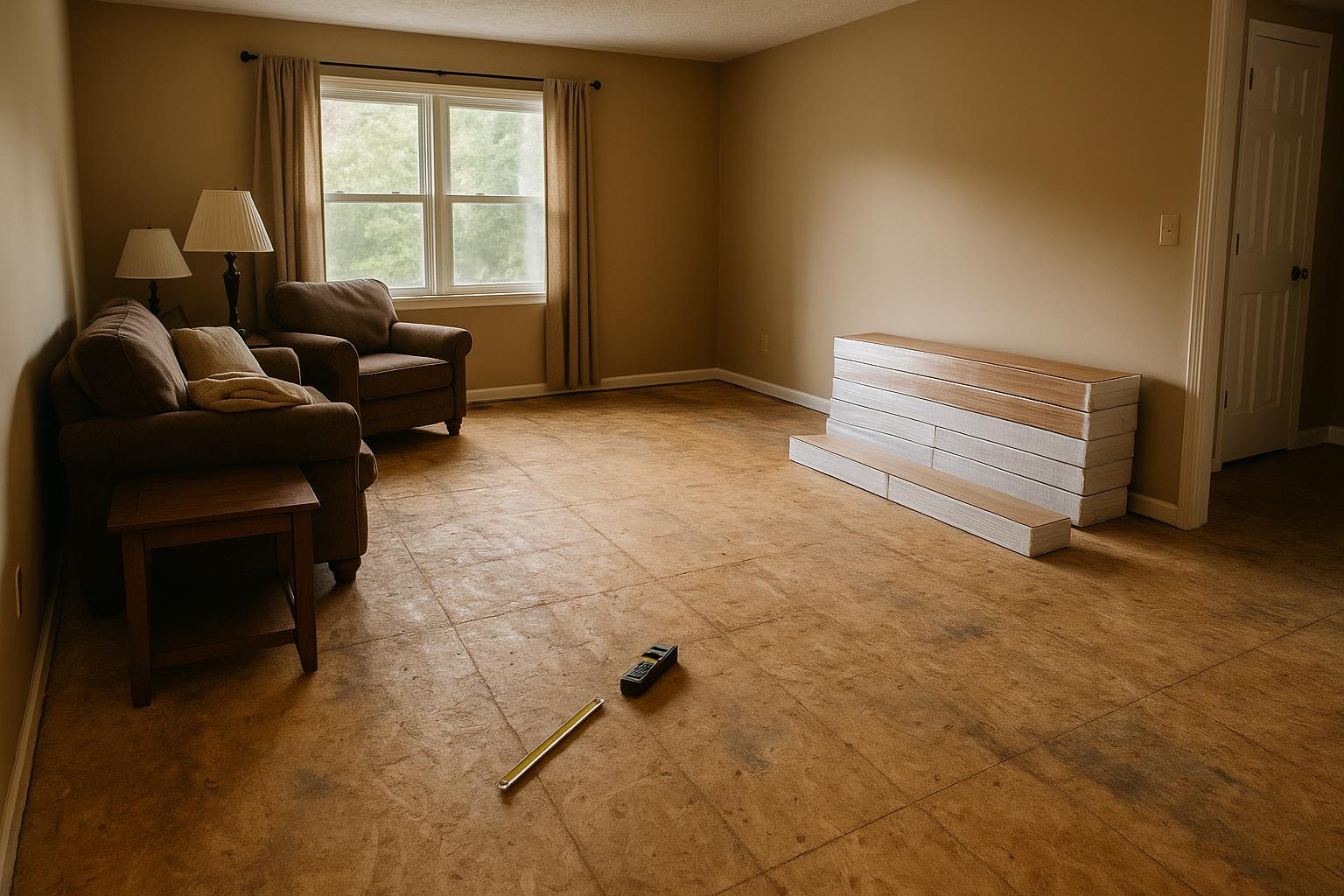
A flooring install goes faster and smoother when both sides know their job going in. Here’s exactly what we handle, what we ask you to handle, and why the schedule looks the way it does.
What you handle before we arrive
- Clear small items, decor, lamps, rugs, and anything breakable out of the work area — pictures off nearby walls if they hang low enough to rattle.
- Arrange for pets and kids to be somewhere else while work is active. Tools, adhesives, and open work zones aren’t a safe place for either, and it keeps our crew moving without stopping to watch the door.
- If it’s a whole-home job, plan to be out of the rooms under work for the day — we’ll walk you through which areas and when as your specific project gets scheduled during your free quote.
What our crew handles
- Moving larger furniture as needed to clear the work area — we’ll confirm exactly what that looks like for your rooms before install day.
- Subfloor prep — checking for damage, leveling, and fixing anything that would telegraph through the new floor. See our full subfloor prep and moisture remediation process for what this actually involves.
- Moisture testing, so we know the subfloor is dry enough to install over before a single plank goes down.
- Acclimation timing — letting your new material adjust to your home’s temperature and humidity on the schedule the manufacturer calls for, not the schedule that’s most convenient.
- The installation itself, done by our residential installation crew.
- Cleanup — removing debris, packaging, and old material so you’re not the one hauling it out.
Done right means done in the right order
Over 20 years of installs has taught us that skipping a prep step to save a day almost always costs the homeowner more later — a squeak, a gap, a floor that cups. We don’t cut that corner. It’s the same standard behind our guide on the signs a floor was installed wrong.
How long will the space be off-limits?
Every job is different — room size, material, subfloor condition, and acclimation needs all affect the timeline. In general, expect the immediate work area to be unusable while installers are actively on it, and a short cure or settle period afterward before it sees full traffic or furniture again. We won’t guess at an exact day count here — during your free quote, we’ll walk your specific space and give you a real timeline, not a generic one.
Why acclimation can’t be rushed
Wood and many other flooring materials expand and contract with humidity. If material goes down straight off the truck without time to adjust to your home’s actual conditions, it can shift after installation — gaps opening up in dry months, boards buckling in humid ones. Acclimation is the waiting period that prevents that: the material sits in the space (or a controlled environment matched to it) long enough to stabilize before installation starts. It’s invisible work — nobody sees it in the finished photos — but it’s one of the biggest reasons a floor installed correctly still looks right five years later.
Frequently asked questions
Do I need to store my furniture somewhere during the job?
For most residential jobs, no offsite storage is needed — we handle moving larger furniture within the home as part of the job. For whole-home projects or unusually tight spaces, we’ll flag anything that needs a different plan during your free quote.
Can I stay in my house during the installation?
Yes, in most cases. You’ll just want to stay out of the immediate work area while it’s active, and keep pets and kids elsewhere during the day. We’ll tell you which rooms and when as part of scheduling.
What happens if the subfloor isn’t ready when you arrive?
We check subfloor condition and moisture levels before installation, not after we’ve already started. If something needs to be addressed first — leveling, drying, repair — we handle it as part of the job rather than installing over a problem.
Get your exact prep checklist
Every home is different. Get a free quote and we’ll tell you exactly what to expect for your space, your material, and your timeline. Prefer to talk now? Call (615) 551-7364.