
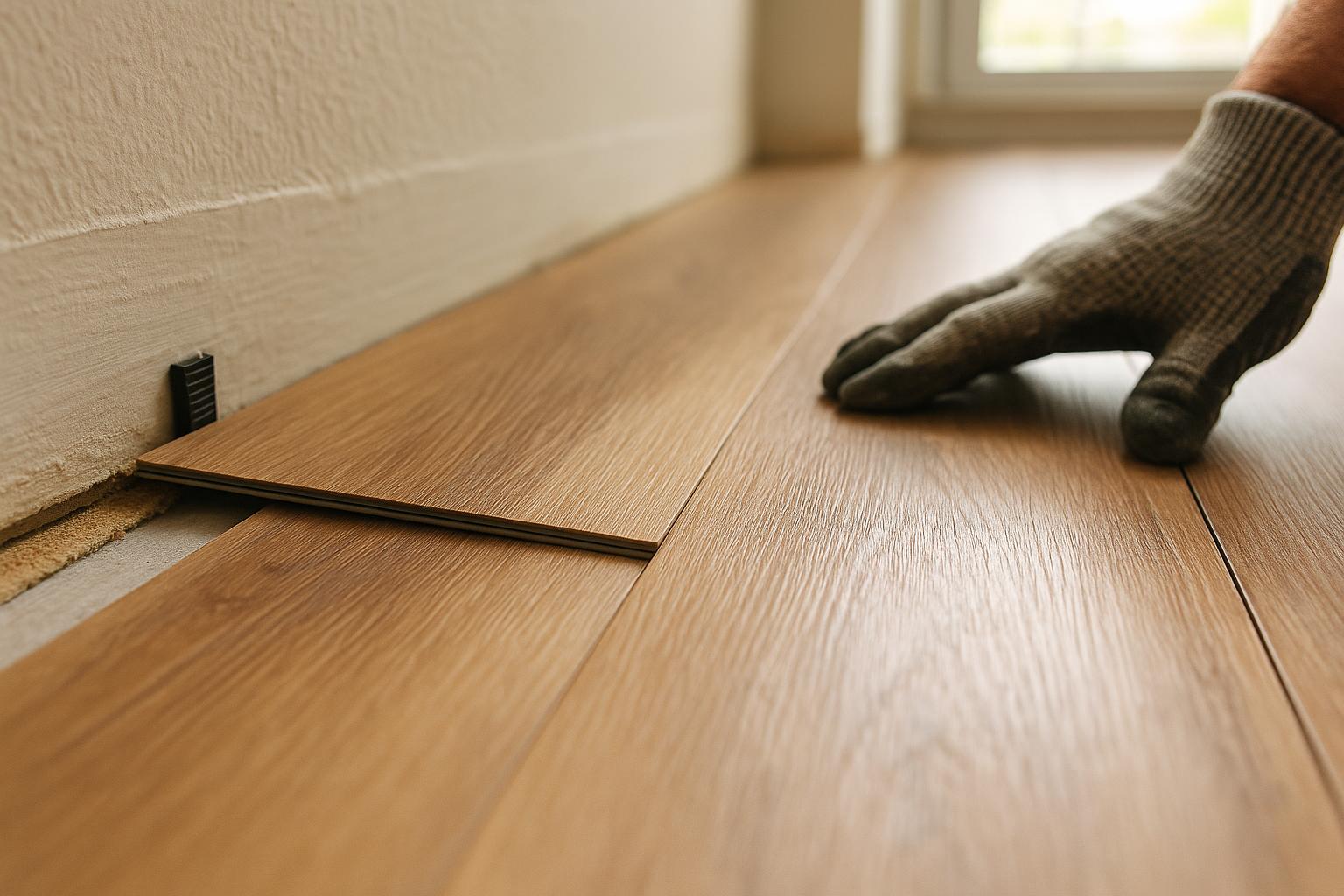
No. A floating floor is engineered to expand and contract slightly with humidity and temperature changes, and nailing or gluing it down defeats that design — it’s a sign of a rushed or incorrect installation, not a legitimate fix.
Why an installer might do it anyway
If a plank keeps shifting, the usual reason isn’t the floor — it’s the install. A floating floor that won’t sit still is telling you the click-lock joints weren’t fully engaged, the subfloor isn’t level enough, or there wasn’t a proper expansion gap left around the room’s perimeter. Reaching for a nail gun or a bead of glue to “hold it down” papers over that problem instead of fixing it. It may look fine the day the crew leaves — it’s far less likely to look fine a year later, once the floor has nowhere to expand and starts buckling or gapping at the fastened points.
What should happen instead
A correctly installed floating floor doesn’t need help staying down: level the subfloor first, test for moisture where it matters, leave the manufacturer’s recommended expansion gap at every wall and transition, and make sure each plank locks fully into the next before moving on. If a room genuinely calls for a fastened floor — some hardwood and certain commercial applications are glue-down or nail-down by design — that’s an intentional method chosen up front, not a shortcut bolted onto a floating system after the fact. Our installers decide which method fits a room before the first plank goes down, not partway through when something isn’t cooperating.
How you’ll know it was done right
No visible fasteners through a floating floor, a consistent gap hidden under the baseboard at every wall, and planks that lock tight without gaps or lippage. That’s the difference between a floor prepped properly — with the subfloor prep and moisture testing it needs — and one that was rushed.
If you’re looking at a floor in your own home right now and something about the installation doesn’t sit right — a plank that was nailed down, a seam that’s opening up, a spot that flexes underfoot — it’s worth a second opinion before it gets worse. Our flooring repair team can diagnose it. And if you’re planning a new install, our vinyl flooring and laminate flooring crews handle the floating-floor method correctly every time — proper prep, real expansion gaps, no shortcuts — on jobs across Murfreesboro and Middle Tennessee.
Can a nailed or glued floating floor be fixed?
Often — a section can be pulled up, the subfloor issue corrected, and the planks relaid properly. If fasteners damaged the plank’s locking edge, replacing that section is the more reliable fix. A quick inspection tells you which situation you’re in.
Does this mean floating floors are unreliable?
No. Floating floors are a proven method when installed correctly. Problems almost always trace back to skipped prep or a fastener used to mask a fitting issue, not the method itself.
Not sure if your floor was installed correctly?
Get a free, honest second opinion from installers with over 20 years of experience in Middle Tennessee — or call (615) 551-7364.